Imagine standing at a Maxwell Food Centre stall, ready to order your favorite dish, but the words just won’t come. You’ve lived in Singapore for months, yet the fear of mispronouncing a tone or blanking on a character keeps you silent. It’s frustrating when you want to connect with colleagues but feel trapped by an academic approach that doesn’t work in the real world. Many professionals feel intimidated by complex Hanzi or worry they’ll waste money on a learn mandarin class that feels like a stiff, high school lecture. You deserve a learning space that respects your time and your goals.
You can achieve conversational fluency without the stress of a traditional classroom. This guide shows you how to find a supportive, adult-only environment that prioritizes practical speaking over abstract theory. We’ll explore how to maximize your financial aid with UTAP and select a course that fits your busy professional life. You’ll discover the exact steps to go from a silent observer to a confident communicator in any local setting. Let’s help you navigate Singapore with ease and build the connections that matter most.
Key Takeaways
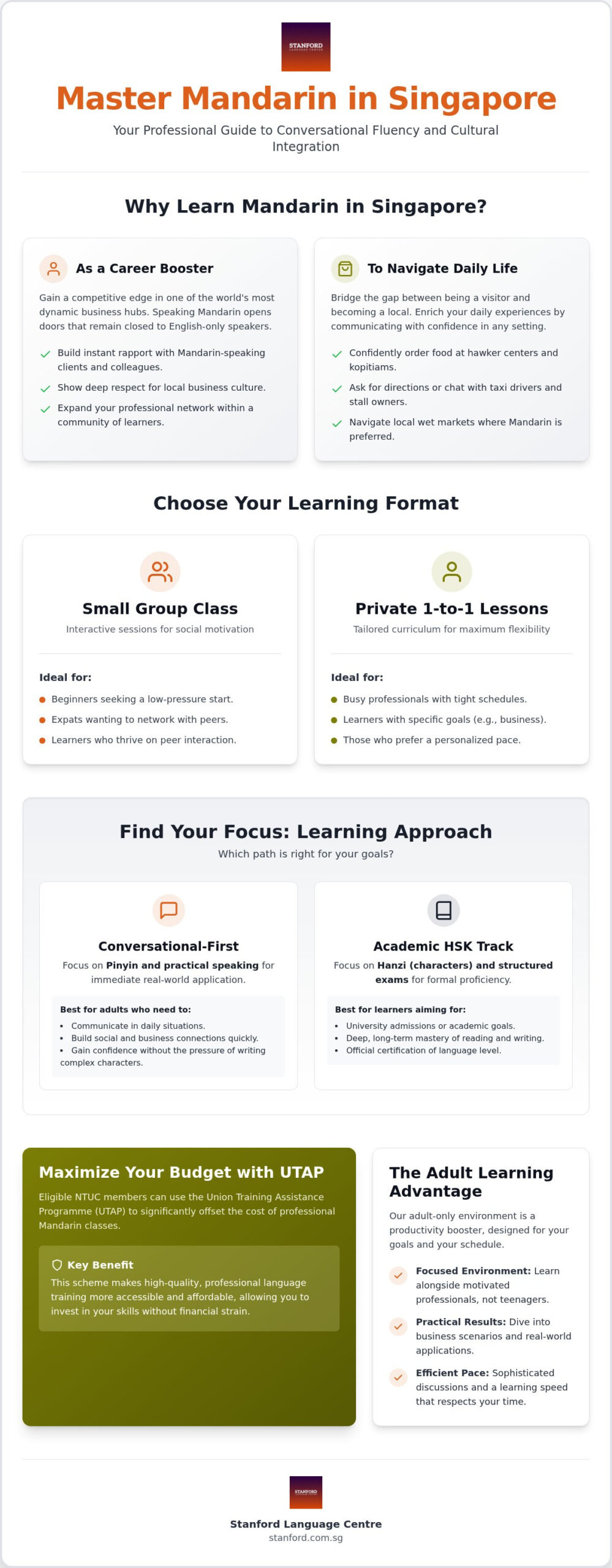
- Learn how Mandarin acts as a career booster and helps you navigate daily Singaporean life, from office meetings to ordering at local hawker centers.
- Compare the benefits of interactive small group sessions with the tailored flexibility of private 1-1 lessons designed for busy professionals.
- Discover why a conversational-first approach focusing on pinyin and speaking is often more effective for adults than traditional academic HSK tracks.
- Find out how to use the NTUC UTAP scheme to significantly offset costs when you join a professional learn mandarin class in Singapore.
- Understand the productivity advantages of a dedicated adult learning environment that prioritizes practical results over theoretical complexity.
Why Join a Mandarin Class in Singapore in 2026?
Singapore’s linguistic landscape is a fascinating mix of tradition and modern business. While English is the primary language for trade and law, Mandarin remains a powerful social and career multiplier. In 2026, the city is more connected than ever. The ability to speak the language opens doors that stay closed to English-only speakers. When you choose to learn mandarin class interactions help you master tones much faster than a solo app could ever manage. This isn’t just about memorizing words; it’s about gaining a competitive edge in one of the world’s most dynamic markets.
Understanding the nuances of Singaporean Mandarin is essential for anyone living in the heartlands. It bridges the gap between being a visitor and being a local. Apps are useful for basic vocabulary, but they can’t correct your pronunciation in real-time or hold you accountable on a rainy Tuesday evening. A structured learn mandarin class provides the social environment and expert guidance needed to move past the “beginner’s plateau.” By 2026, the rise of hybrid learning models has made these classes more accessible and flexible for the modern professional.
Daily life in Singapore becomes much richer when you can speak the language. Imagine the following scenarios:
- Ordering your “teh o bing” or “cai fan” with specific instructions at a local kopitiam.
- Asking for directions or clarification in a crowded HDB estate without hesitation.
- Building an immediate bond with taxi drivers or stall owners who appreciate your effort.
- Navigating local wet markets where Mandarin is often the preferred language for haggling.
Mandarin for Professionals and Expats
In the CBD, small talk is a big deal. Being able to exchange pleasantries with a Mandarin-speaking client or colleague builds instant rapport and shows deep respect for the local culture. For many foreigners, these skills are the ultimate “culture shock” reducer. You stop feeling like an outsider and start feeling like a resident. Beyond the office, you’ll join a community of fellow adult learners. These cohorts often become valuable networking circles, connecting you with other expats and professionals who share your drive for self-improvement.
Singapore’s Adult-Only Learning Advantage
Learning as an adult requires a specific approach. You have clear goals and very little time to waste. A dedicated adult-only language school ensures you aren’t sitting in a room full of children or teenagers. This focused environment is a massive productivity booster. You can dive into business scenarios, discuss professional networking, and practice real-world applications that matter to your life. It’s a no-frills, high-value space where every lesson is designed for a mature audience, allowing for deeper discussions and a more sophisticated learning pace.
Choosing Your Format: Small Group vs. Private Mandarin Lessons
Deciding how to start your journey is a balance between your personal schedule and your preferred learning style. If you want to join a learn mandarin class, group environments offer a unique mix of social motivation and expert guidance. For others, the privacy and pace of a one-on-one session are more productive. Both paths lead to fluency, but the right choice depends on your specific goals in Singapore’s fast-paced professional world.
Small Group Mandarin Class for Expats
Small groups, usually limited to 8 or 10 students, provide a low-pressure setting that’s perfect for beginners. There is a psychological benefit to practicing tones alongside peers who are making the same mistakes. It removes the fear of judgment. At SLC, we structure our Level 1 courses to ensure the pace is steady and inclusive. No one is left behind. You can find more details on this in our 2026 Guide: Adult Chinese Learning in Singapore. These sessions often turn into networking opportunities, connecting you with other expats in the city.
Tailored Classes for Japanese and Korean Speakers
We recognize that learners from East Asia don’t start from zero. Japanese and Korean speakers can leverage their existing knowledge of Kanji and Hanja to recognize characters much faster than Western learners. However, they often encounter unique pronunciation hurdles that standard curricula overlook. A “one-size-fits-all” English-to-Mandarin curriculum is often inefficient for these groups. By addressing these specific linguistic patterns, we help students accelerate their progress significantly. It’s a pragmatic approach that respects your existing knowledge while focusing on the areas where you need the most support.
For those with unpredictable schedules, private 1-1 lessons offer maximum flexibility. This is often the preferred route for C-suite executives and frequent travelers who can’t commit to a fixed weekly slot. You get the instructor’s full attention, allowing you to focus on specific business vocabulary or cultural nuances relevant to your industry. While you might find a SkillsFuture-eligible Mandarin course through general directories, many adults find that a specialized, adult-only school offers a more professional atmosphere. Today’s hybrid models also allow you to switch between online and in-person sessions, ensuring your progress never stalls. Choosing the right learn mandarin class is the first step toward professional fluency. If you’re ready to find your fit, you can explore the various Mandarin class for adult options available to suit your lifestyle.
Conversational Mandarin vs. HSK: What Should You Study?
Choosing between an academic certificate and real-world speaking is a common crossroads for many. HSK (Hanyu Shuiping Kaoshi) is the standardized test for non-native speakers. It’s great for university applications or formal job requirements in mainland China. But for most adults in Singapore, it can feel like a long detour. If your goal is to order food or talk to colleagues, a conversational-first approach is much faster. It prioritizes pinyin and speaking. You don’t need to master 2,000 characters to be effective at work.
When you join a learn mandarin class, you want results you can use tomorrow. Academic tracks often spend weeks on character strokes; a pragmatic course focuses on the four tones and basic sentence structures instead. This foundation allows you to start communicating immediately. While some might look for a Mandarin for Adults – Beginner Level 1 course for general knowledge, a professional environment ensures you’re learning alongside peers with similar career-driven motivations. Practicality always beats theory in a busy city like Singapore.
The Roadmap to Conversational Fluency
Our Level 1 curriculum is designed for absolute beginners. We break down the language into manageable segments. You’ll master the “building blocks” of sentences without getting bogged down in dense grammar. A conversational focus acts as a tool for immediate local integration by giving you the confidence to speak from day one. Finding the right learn mandarin class means choosing a path that matches your lifestyle. Once you have the basics, transitioning to intermediate business Mandarin becomes a natural, low-stress next step.
Practical Mandarin for the Singapore Workplace
Standard Chinese is the foundation, but the local workplace has its own rhythm. You’ll need specific phrases for office meetings, professional emails, and networking. There’s also the nuance of “Singdarin,” where local slang and English loanwords often mix in. Understanding this helps you sound more like a local partner and less like a textbook. For companies, corporate training solutions bring this learning directly to the office. It’s efficient; it’s tailored; it works. You’ll build better rapport with Chinese-speaking clients when you understand the cultural context behind the words.
Maximizing Your Budget: UTAP vs. SkillsFuture Credits
Many people in Singapore believe that SkillsFuture is the only way to fund professional development. That’s a huge misconception. If you’re looking to join a learn mandarin class, there’s another powerful tool available to you: NTUC UTAP. The Union Training Assistance Programme (UTAP) is designed specifically for workers who want to upgrade their skills without breaking the bank. It offers a practical alternative for those who may have already exhausted their SkillsFuture credits or are looking for a different way to offset their learning costs.
As of August 2026, NTUC members can receive 50% unfunded course fee support for approved training. This is a significant benefit for anyone serious about their career. For members below 40 years old, the funding is capped at S$250 per year. If you’re 40 and above, that cap increases to S$500 per year. At SLC, we choose to offer UTAP-claimable courses because they provide a reliable, value-driven path for both local and expat workers. It’s about making high-quality education accessible to those who are invested in their professional growth.
How to Claim Your UTAP Benefit
The claim process is straightforward and results-oriented. First, you must be an NTUC member before the course starts. This eligibility extends to foreigners and expats, making it a versatile option for the entire workforce. Once you’ve registered for a learn mandarin class and paid your fees, you simply need to maintain a minimum attendance of 75%. After the course ends, you submit your claim via the NTUC portal. While SLC does not accept SkillsFuture credits, UTAP offers significant fee support that makes our professional courses very affordable. It’s a no-frills way to get the training you need while keeping your budget in check.
Cost-Benefit Analysis of Language Learning
Think of language learning as a long-term investment rather than a one-time expense. The ROI of being able to communicate with Chinese-speaking stakeholders can be massive for your career. However, you should always look out for hidden costs like registration fees or expensive materials that some schools add on later. We believe in a transparent approach. While “cheaper” community center classes exist, they often lack the professional rigor and adult-only atmosphere that busy executives require. You aren’t just paying for a seat; you’re paying for an environment that respects your time and goals. If you’re ready to start, you can explore our NTUC Utap claimable Mandarin class options today.
Why Stanford Language Centre is the Preferred Choice for Adults
Stanford Language Centre (SLC) has been a cornerstone of adult education in Singapore since 2004. We don’t try to be everything to everyone; we focus exclusively on professional learners. This means when you join a learn mandarin class here, you won’t find children or teenagers in the room. This adult-only environment is a massive productivity booster. It allows for a mature, focused atmosphere where the curriculum is tailored to real-world business and social scenarios. Our small, manageable class sizes ensure that you get the individual speaking time necessary to build confidence quickly. We prioritize your ability to speak and understand, rather than just pass a written test.
Our track record with expats, foreigners, and corporate clients speaks for itself. We understand the unique pressures of the Singaporean workplace. Over the decades, we’ve refined our methods to ensure that busy professionals can see tangible results within weeks. Whether you prefer the energy of our central Singapore locations or the flexibility of our online options, we accommodate your schedule. We know that consistency is the key to language acquisition, so we make it as easy as possible for you to attend every session without stress. It’s a pragmatic approach for a fast-paced city.
The SLC ‘Friendly Guide’ Philosophy
Our instructors are more than just teachers; they are supportive mentors who understand the hurdles of learning a new language later in life. They are passionate experts who know how to simplify complex linguistics. They break down the intimidating aspects of Mandarin into digestible, logical steps. This supportive environment is specifically designed to lower the barrier to entry for absolute beginners. You’ll hear real success stories from our expat community, where students have gone from zero knowledge to navigating local markets and office meetings with ease. We view ourselves as your partners in this journey, providing the encouragement you need to keep moving forward.
Ready to Start Your Mandarin Journey?
Taking the first step is often the hardest part. To help you get started, we recommend a quick assessment of your current level. For most beginners, Level 1 provides the essential building blocks of the language. Our enrollment process is designed to be no-frills and straightforward. Whether you are interested in a small group learn mandarin class or private 1-1 sessions for your team, we handle the logistics so you can focus on learning. It’s time to move beyond the basics and achieve the professional fluency you need to thrive in Singapore. Join a Trial Class or Enroll in our Next Intake at Stanford Language Centre and see the difference a dedicated adult environment makes.
Take the Next Step Toward Professional Fluency
Achieving conversational fluency doesn’t have to be an intimidating or academic chore. By choosing a specialized adult-only curriculum, you bypass the distractions of a typical classroom and focus on the practical skills you need for life in Singapore. Whether it’s for professional networking in the CBD or navigating local heartlands, the right learn mandarin class will prioritize speaking and listening from day one. You now know how financial aid like NTUC UTAP can significantly lower your investment, making this a pragmatic choice for any career-focused individual.
Since 2004, Stanford Language Centre has been a trusted local partner in providing these results-oriented environments. We ensure every lesson is relevant to your professional life. Our instructors act as supportive mentors to help you break through the language barrier with confidence. Your path to mastering Mandarin is clearer than ever. It’s time to turn your goals into real-world communication skills.
Start Your Mandarin Journey: View Our Class Schedules
Your new language skills are waiting. We look forward to seeing you in class and helping you navigate Singapore with ease.
Frequently Asked Questions
Do I need to know how to write Chinese characters to start a Mandarin class?
No, you don’t need to master characters to begin your journey. Most adult learners start with pinyin, which uses the Roman alphabet to represent sounds. This allows you to focus on speaking and listening immediately. While characters are introduced later, the priority in a beginner learn mandarin class is building the confidence to hold basic conversations in everyday Singaporean settings. It’s a pragmatic way to see results quickly.
Can I use my SkillsFuture credits at Stanford Language Centre?
Stanford Language Centre does not accept SkillsFuture credits for its courses. Instead, we focus on providing high-quality, professional training that is NTUC UTAP claimable. This union benefit offers significant fee support for NTUC members, including foreigners and expats. It’s a great way to manage your budget while ensuring you’re in a dedicated adult-only environment. We believe this focus on professional learners provides better long-term value than general community-based courses.
How long does it take to become conversational in Mandarin?
Most students gain basic conversational foundations after completing a Level 1 course, which typically consists of 10 lessons. You’ll be able to handle simple interactions like ordering food or introducing yourself. Achieving professional fluency takes longer and depends on your practice outside the classroom. Our conversational-first approach is designed to get you speaking from day one, ensuring you can use what you learn in a learn mandarin class immediately at work.
Is UTAP available for foreigners and expats in Singapore?
Yes, UTAP is available to foreigners and expats who are NTUC members. This is a common point of confusion, but as long as you have a valid membership, you can claim 50% of the unfunded course fees. This support is capped at S$250 per year for those under 40 and S$500 for those 40 and above as of 2026. It’s a fantastic incentive for the international community in Singapore to invest in local language skills.
What happens if I miss a Mandarin class due to work travel?
We understand that busy professionals often have unpredictable schedules. If you miss a session due to work travel, we offer flexibility through our other ongoing classes or online catch-up options. Our goal is to ensure you don’t fall behind your cohort. Just let our team know in advance, and we’ll help you find a suitable make-up slot. This flexibility is one reason why we are a preferred choice for corporate executives in Singapore.
Are there specialized Mandarin classes for Japanese or Korean speakers?
Yes, we offer specialized tracks specifically for Japanese and Korean speakers. These learners often have a head start because of their familiarity with Kanji or Hanja characters. However, they face specific pronunciation challenges that differ from Western learners. Our instructors use tailored methodologies to leverage your existing knowledge while focusing on the unique tones of Mandarin. This specialized approach makes your learning journey much more efficient and productive than a standard curriculum.
What is the difference between Level 1 Mandarin and HSK 1?
Level 1 Mandarin at SLC focuses on conversational foundations, while HSK 1 is an academic exam-prep track. HSK often requires you to learn specific vocabulary for a test, which might not be useful in a Singaporean office. Our Level 1 curriculum is designed for immediate application. We prioritize pinyin, tones, and sentence structures that help you navigate daily life and professional networking. It’s about practical utility over just getting an academic certificate.
Does the school provide corporate Mandarin training for companies?
Yes, we provide Corporate Mandarin Language Training tailored to your company’s specific needs. We can bring the classroom to your office or host your team at our central locations. Our corporate programs focus on industry-specific vocabulary and cultural nuances that matter in a business context. This is an excellent way for teams to build rapport with Chinese-speaking stakeholders. We work with you to create a schedule that fits your organization’s operational requirements.