What if your team could build stronger business rapport without needing academic fluency? The right corporate vietnamese language training singapore can help employees develop practical conversational skills, starting with foundational language they can use in everyday professional interactions.
If your staff feel unsure about communicating across cultures, a clear training plan can help. Start by identifying the situations employees want to handle, then choose a format that fits their roles and work schedules. Foundational Level 1 Vietnamese offers a structured starting point, with conversational learning rather than an initial focus on advanced language theory.
This guide explains how to match training to your team’s goals and compare course content, format and costs. You’ll also learn how eligible learners may use NTUC UTAP to offset course fees. Stanford Language Centre provides foundational Vietnamese learning for adults and corporate teams, with dedicated corporate training tailored to business communication needs. The aim is to help your people practise useful skills and approach conversations with greater confidence.
Key Takeaways
- Identify the everyday business interactions where foundational Vietnamese could help employees build rapport.
- Compare courses by their beginner content, practical focus, delivery format and fit with your team’s work schedule.
- Choose between small-group learning and private 1-to-1 lessons based on whether employees share goals or need individual focus.
- Understand how eligible employees may use NTUC UTAP for claimable Vietnamese classes.
- Explore corporate vietnamese language training singapore through Stanford Language Centre, with foundational conversational learning for adults and teams.
The Strategic Value of Corporate Vietnamese Language Training in Singapore
For businesses building relationships in Vietnam, communication extends beyond formal meetings. Employees may interact with local colleagues, suppliers and customers during introductions, visits and routine coordination. Foundational Vietnamese can give them a way to take part in simple exchanges and make an effort to connect in the other person’s language.
English may support many business discussions, but it won’t cover every interaction. A greeting or a simple phrase in Vietnamese can signal respect and openness. Language learning doesn’t replace commercial planning or professional expertise, but it can help conversations feel more personal and welcoming.
Vietnamese has its own history and global presence; readers can explore an overview of the Vietnamese language for added context. Business learners don’t need to begin by aiming for fluency. Foundational skills can help employees open a conversation, introduce themselves and manage simple exchanges during networking or day-to-day work.
Why Foundational Conversational Skills Matter
Useful beginner goals include greeting a contact, making an introduction and responding politely in a simple exchange. Employees can practise these situations before a meeting or visit, rather than relying on a colleague for every basic interaction. For field teams, familiar phrases can also support regular contact and routine coordination.
In a Vietnamese business context, rapport is the trust and professional goodwill built through respectful communication, attentive listening and consistent follow-through.
Trust develops over time, not from a handful of phrases alone. Still, learning and practising useful language can help employees approach new relationships with greater confidence.
Singapore-Vietnam Business Synergy in 2026
Cross-border work depends on clear communication across teams. In manufacturing, employees may need to manage routine exchanges at a worksite. In technology, conversational skills can support relationship-building between project leads and partners. In logistics, they may help make introductions and everyday coordination more personal. These are practical starting points, not substitutes for technical or professional expertise.
Language effort can also contribute to a positive tone before business terms are discussed. Employees who can greet contacts, follow basic social exchanges and communicate respectfully may find it easier to begin a conversation. This supports the relationship around a negotiation, but does not guarantee a particular outcome.
For companies developing communication skills across multiple languages, the 2026 guide to adult Chinese learning in Singapore offers a related perspective. The same practical principle applies: begin with skills employees can use and build from there. Thoughtfully designed corporate vietnamese language training singapore can give teams a manageable first step toward more confident cross-border communication.
Choosing the Right Corporate Vietnamese Course: A 2026 Evaluation Framework
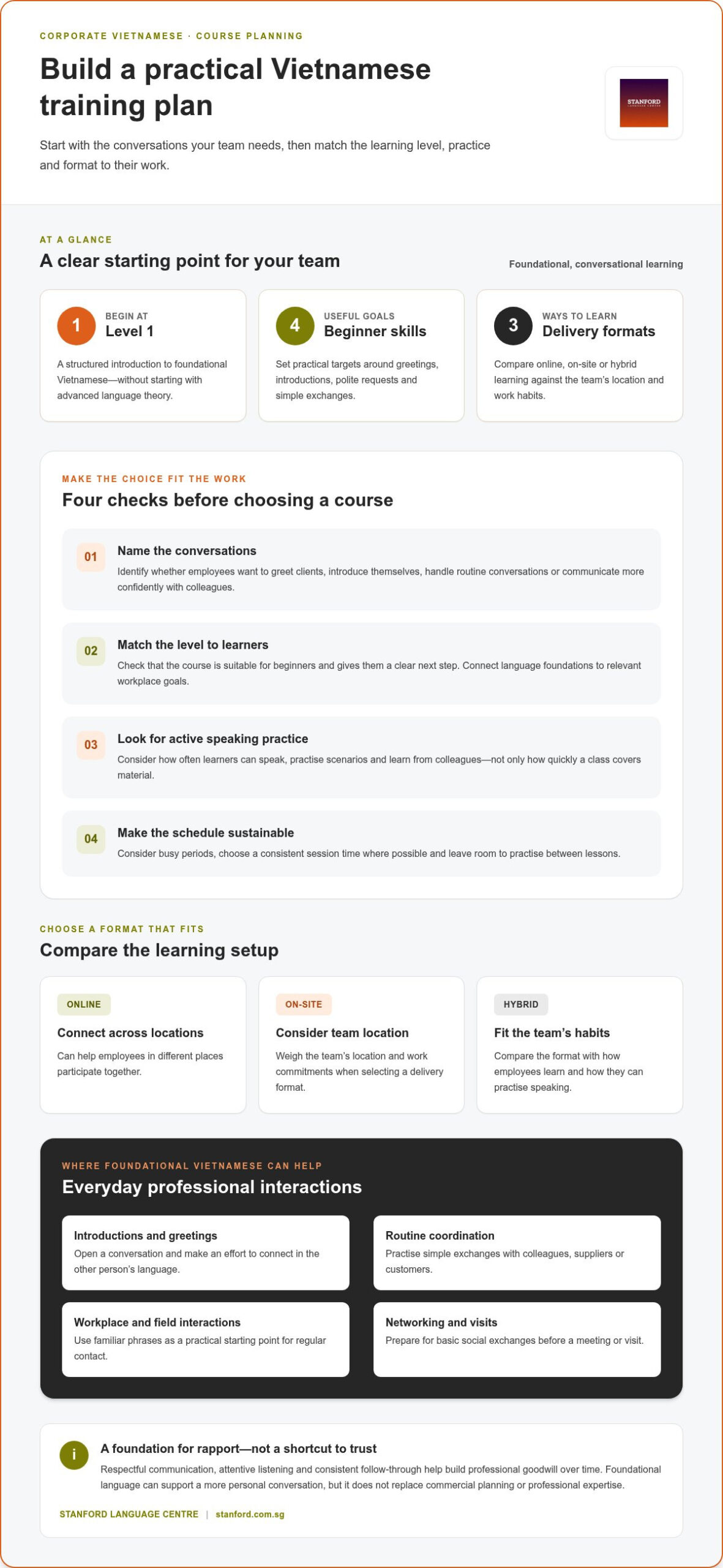
Start by defining what employees need to do. Are they learning to greet clients, make introductions, take part in routine conversations or communicate more confidently with colleagues? A specific goal makes it easier to choose relevant learning content, a suitable format and a schedule employees can follow.
Curriculum: Foundational vs. Fluency-Based
For beginners, Level 1 is a practical place to start. It provides a structured introduction to foundational language and conversation without requiring learners to master advanced Vietnamese before using what they learn. Stanford Language Centre’s foundational Vietnamese courses are designed for adults and corporate teams, with a focus on practical conversation.
When comparing course plans, look for a connection between general language foundations and your team’s workplace goals. For example, employees might practise greetings, introductions, polite requests or simple exchanges relevant to their roles. Ask whether the course’s stated level matches the learners’ experience, and whether the learning path gives beginners a clear next step. A focused plan makes practice more purposeful than studying material with no obvious connection to employees’ interactions.
Delivery Modes: Online, On-site, or Hybrid?
Choose a delivery format that works for the team’s location and learning habits. Online Vietnamese classes can help employees in different places participate together. For any format, consider how learners will get opportunities to practise speaking and how the sessions fit around work commitments.
Scheduling matters just as much as the format. Look at the team’s busiest periods, set a consistent session time where possible and leave room for practice between lessons. A realistic schedule is easier to sustain than one that repeatedly competes with core responsibilities.
Class size also shapes the learning experience. Smaller groups can give participants more chances to speak, practise scenarios and learn from colleagues. When comparing options, consider how much active practice each learner will get, not only how quickly the class covers material. The goal is to help employees become more comfortable using foundational language.
Corporate training should connect to employees’ professional needs. Stanford Language Centre provides corporate Vietnamese training tailored to business communication needs, alongside online language classes. When setting learning goals, describe the interactions employees want to handle and use those goals to guide the training plan. For a wider view of employee language learning, explore the guide to adult Chinese learning in Singapore.
Include funding in your comparison. Eligible NTUC members may be able to use the NTUC Union Training Assistance Programme (UTAP) for qualifying training, subject to the scheme’s terms. Review the current details alongside your team’s goals, schedule and learning format.
For a practical starting point, explore Stanford Language Centre’s corporate Vietnamese training and consider how foundational lessons could support your team’s day-to-day communication.
Small Group vs. Private 1-1 Vietnamese Lessons for Professionals
The best format depends on who needs Vietnamese and how they’ll use it. A department developing shared communication skills may benefit from learning together. An employee with a specific project or individual learning goal may benefit from more focused lessons. Match the format to the business need so that employees can practise relevant skills.
The Benefits of Small Group Vietnamese Classes
Small-group lessons give employees a setting to practise with colleagues and learn together. Learners can take turns making introductions, trying a simple client conversation or practising a routine workplace exchange. They can also hear how colleagues approach the same scenario and use that as a prompt for further practice.
For a department, a shared class can be more cost-efficient than arranging individual lessons for every employee. It also gives colleagues a common foundation for cross-border interactions. Stanford Language Centre’s small-group Vietnamese classes focus on foundational conversation for adults. For useful practice ideas, see this practical guide to learning a tonal language.
When to Opt for Private Vietnamese Lessons
Private 1-to-1 lessons can suit a professional with a specific goal, such as preparing for a project, relocation or important business interactions. The individual format gives the learner focused attention and room to practise at their own pace.
This option may work well for senior leaders or employees with demanding schedules whose learning priorities differ from those of a wider team. Private Vietnamese lessons are useful when an individual needs a more focused approach than shared group learning provides.
Keep Progress Visible
Set practical milestones before training begins. For example, learners might work toward greeting a contact, making a basic introduction or taking part in a simple exchange. These goals let managers and employees discuss progress in concrete terms rather than relying only on a general impression of confidence.
Group lessons can help a department work toward shared milestones, while private lessons can focus on individual priorities. A blended approach may also make sense: use group learning for common foundations, then add individual support where a role calls for more targeted practice. With corporate vietnamese language training singapore, choose the balance that lets each learner practise useful skills in a way that fits their work.
Managing Costs: NTUC UTAP and Corporate Training ROI
Course fees are only one part of the investment. A useful budget also accounts for how employees will apply their skills, whether lessons fit work requirements and how the company can support continued learning. Eligible employees may be able to use NTUC UTAP to offset part of the cost of claimable Vietnamese training, while a focused course gives the team practical goals to work toward.
How to Claim UTAP for Vietnamese Courses
UTAP is an individual training support scheme for paid-up NTUC members, not a general corporate grant. Under the current scheme, eligible members can claim 50% of unfunded course fees, subject to an annual cap of S$250 for members under 40 and S$500 for members aged 40 and above. The course can’t be fully sponsored by the employer, and members need to meet the minimum 75% attendance requirement.
- Check eligibility: Confirm the employee is a paid-up NTUC member and review the course’s claimable status and current UTAP terms.
- Plan employer support: Account for the rule that a fully employer-sponsored course isn’t eligible for an individual UTAP claim.
- Complete the course: The employee must meet the attendance requirement.
- Submit the claim: Apply within six months of course completion, following the current UTAP claim process.
SkillsFuture credits aren’t applicable to these Vietnamese courses. UTAP support depends on the scheme’s eligibility rules and the member’s available annual balance. Check the current terms before including an expected claim in your budget.
The Business Case for Foundational Language Skills
Foundational Vietnamese won’t replace professional translation for complex or high-stakes material. It can help employees handle basic greetings, introductions and routine exchanges without relying on an intermediary for every interaction. To assess value, set a clear goal before training begins, then review whether employees can use the target skills in relevant work situations.
Consider the broader return as well. Shared training gives colleagues a common starting point for communication, and practical professional development may support employee engagement. Results depend on the team and how learning is applied, so connect training goals to real business needs instead of assuming a guaranteed return.
For organizations building language skills across teams, the 2026 guide to Thai language courses in Singapore offers another perspective on planning workplace learning. Stanford Language Centre provides practical Vietnamese training for adults and corporate teams, focused on foundational conversation. Explore corporate Vietnamese training options to plan an approach that fits your team.
Why Stanford Language Centre is the Preferred Partner for Vietnamese Training
Corporate language learning is most useful when it connects to employees’ goals. Stanford Language Centre provides Vietnamese courses for adults and corporate teams, with a focus on foundational conversational skills. Beginners can start with practical Level 1 learning and build from there, rather than being expected to tackle advanced language first.
A clear starting point can make learning feel more manageable. Employees can set achievable goals and practise using foundational language in everyday conversations. For businesses, this means focusing training on practical skills employees can work toward, rather than expecting fluency before they can participate.
Our Friendly and Encouraging Learning Environment
Learning a tonal language can feel unfamiliar at first. Adults benefit from having space to practise, make mistakes and improve. Stanford Language Centre’s practical approach focuses on foundational communication rather than dense academic study, giving learners a clear way to work on conversational skills.
For busy professionals, a relevant starting point matters. When employees can connect lessons to real interactions, it’s easier to see what they’re practising and how the skills may be used at work.
Corporate Training That Fits Professional Needs
Teams have different reasons to learn. Some may want Vietnamese for basic workplace interactions, while others may have communication goals involving Mandarin or Thai. Stanford Language Centre provides corporate training in Vietnamese, Mandarin and Thai, as well as online language classes. These options support organizations planning language learning for employees with different roles and working arrangements.
Set clear goals for the team, such as practising introductions or building confidence in routine conversation. Specific outcomes help keep training relevant to employees’ work and make progress easier to discuss. Stanford Language Centre’s corporate Vietnamese training focuses on foundational skills for adult learners.
Ready to plan a practical first step for your team? enquire about corporate Vietnamese training at Stanford Language Centre.
Give Your Team a Practical First Step Toward Vietnam
Effective language training doesn’t have to begin with academic fluency. Start with your team’s communication goals, choose a format that suits employees’ roles and focus on foundational conversation they can practise in business settings. Small groups can build shared skills, while private lessons give an individual learner focused attention.
The right corporate vietnamese language training singapore can help employees approach cross-border communication with greater confidence. Stanford Language Centre provides foundational Vietnamese courses for adults and corporate teams. Eligible learners may also benefit from NTUC UTAP claimable programs, subject to the scheme’s terms.
Ready to explore a training approach for your team? Enquire about corporate Vietnamese training and take the first step toward practical language learning for your employees.
Frequently Asked Questions
Is Vietnamese hard for English speakers to learn for business?
Vietnamese can take practice, especially as learners get used to its tones and pronunciation, but business beginners don’t need to aim for fluency straight away. Start with foundations such as greetings, introductions and simple everyday exchanges. A structured Level 1 conversational course gives English speakers a manageable way to practise language for professional interactions.
How long does it take to complete Level 1 Conversational Vietnamese?
Completion time depends on the course schedule and learning format. Stanford Language Centre provides structured foundational Vietnamese learning for adults and corporate teams, with a focus on practical conversation. When planning around a project or employee schedule, consider the timetable and how much time learners can set aside for practice between lessons. Consistent participation helps reinforce new vocabulary and pronunciation.
Can my company claim NTUC UTAP for Vietnamese language lessons?
UTAP claims are made by eligible individual NTUC members, rather than by the company as a corporate claim. A paid-up member may claim 50% of unfunded course fees, subject to the annual cap: S$250 for members under 40 and S$500 for those aged 40 and above. Members must meet the 75% attendance requirement, and the course can’t be fully employer-sponsored. Claims are due within six months of course completion.
Do you provide on-site Vietnamese training at our office?
Stanford Language Centre provides corporate Vietnamese training tailored to business communication needs. When planning training for your team, consider employees’ roles, learning goals and work schedules, then set practical outcomes such as practising introductions or routine conversation. The focus is on helping adult learners build useful foundational conversational skills.
What is the difference between a small group class and private 1-1 lessons?
A small-group class lets colleagues practise together through conversation and shared activities, making it a practical format for teams building common foundational skills. Private 1-to-1 Vietnamese lessons give an individual learner focused attention and allow learning to follow their needs. Choose a group format for shared team goals, or private lessons when an employee needs a more individual pace or focus.
Are there online Vietnamese classes available for regional employees?
Yes. Stanford Language Centre offers online Vietnamese classes, which can make it easier for employees in different locations to learn together. Online lessons are a useful option for teams seeking a shared starting point in foundational conversation. Regular participation and practice between classes help employees reinforce pronunciation and prepare to use Vietnamese in everyday professional interactions.
Does the course cover Vietnamese business etiquette and culture?
The course focus is foundational conversational Vietnamese for practical use. Greetings, introductions and polite exchanges can help employees approach business interactions more confidently and communicate respectfully. These language skills can support rapport, but they aren’t a complete course in Vietnamese business culture or etiquette. Teams can begin with conversational foundations and apply them thoughtfully in their own work settings.
What happens if a student misses a corporate training session?
A missed session can make it harder to keep pace, so learners should attend consistently and catch up on the language covered as soon as they can. Attendance also matters for eligible UTAP claims, which require a minimum of 75% course attendance. For teams, tracking participation and sharing a clear schedule helps employees plan around work commitments and stay engaged with their Vietnamese learning.