Mastering a tonal language like Thai isn’t about having a musical ear; it’s about having the right roadmap. You’ve likely tried the free apps and felt the frustration of inconsistent progress. Maybe you’re worried about finding a class that doesn’t feel like a primary school room. It’s common to feel overwhelmed by the five tones or confused about which government subsidies actually apply to your learning journey in Singapore.
We understand that as a busy professional, you need results that stick. This guide shows you how to choose professional Thai lessons that turn initial hesitation into confident, real-world conversation. You’ll discover how to move from a complete beginner to a conversationalist using structured, adult-centric methods that prioritize practical utility over academic fluff. We’re here to help you navigate the process without the stress.
We’ll explore how to master those tricky tones, use NTUC UTAP subsidies to offset your costs, and find a supportive environment where you can network with other adult learners. You will learn exactly what to look for in a course to ensure your time and effort lead to genuine fluency.
Key Takeaways
- Learn why a conversation-first approach is the fastest way for adults to master Thai tones and basic grammar.
- Compare the social benefits of small group classes with the focused, fast-tracked progress of private 1-1 sessions.
- Understand the step-by-step roadmap that takes you from foundational Level 1 basics to reading and writing proficiency.
- It’s simple to reduce your out-of-pocket expenses by applying for NTUC UTAP subsidies for your Thai lessons.
- See how an adult-focused environment helps lower the barrier to entry and builds your confidence quickly.
What to Expect from Professional Thai Lessons in 2026
Professional Thai lessons in 2026 are built for busy adults who need results without the fluff. Results that stick. These programs prioritize practical communication over abstract academic theory. You’ll find that the focus is on two core areas: mastering the five tones and understanding basic sentence structures. It’s about giving you the tools to speak correctly from day one. Instead of a rigid classroom feel, these sessions offer a supportive environment that lowers the barrier to entry for new learners. It’s a welcoming space where mistakes are just part of the progress.
Adult-centric learning differs significantly from traditional school-style teaching. You won’t find yourself buried in dry textbooks or memorizing archaic poetry. Instead, the curriculum centers on real-world utility. This means you’ll learn how to navigate social and professional settings while picking up the cultural nuances that make your Thai sound more natural. It’s a pragmatic approach. No-frills quality for people who value their time and want to see consistent, tangible progress in every session.
The Tonal Challenge: Why Guidance Matters
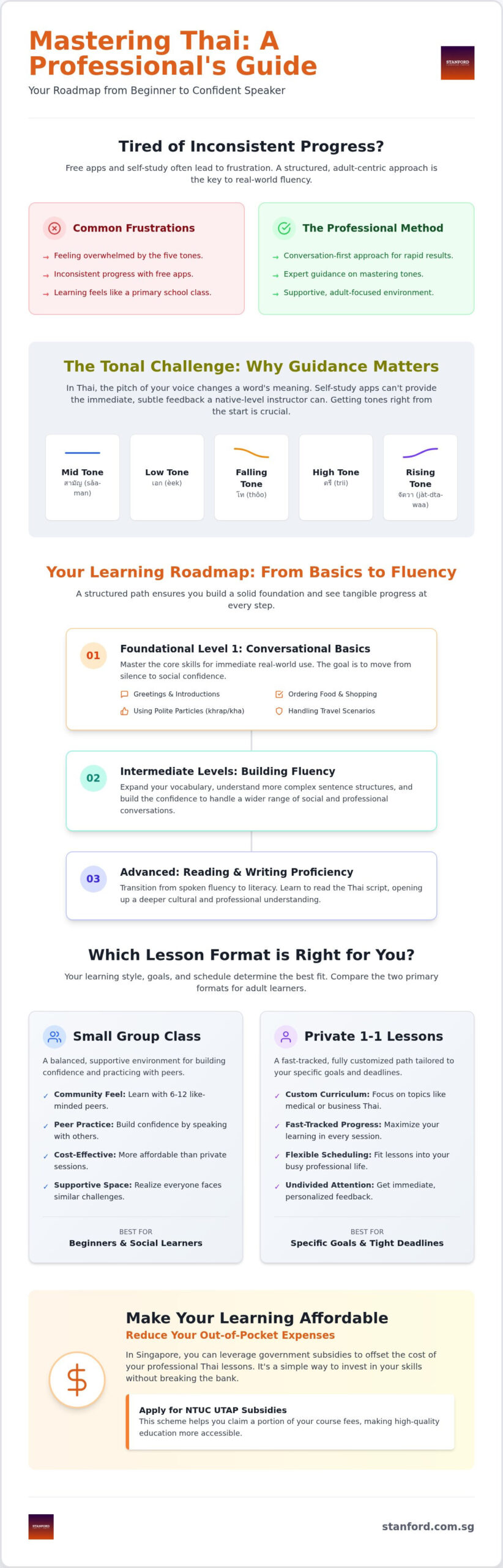
Thai is a tonal language. The pitch of your voice determines the meaning of the word. For a detailed Thai language overview, you can explore how the five distinct tones; mid, low, falling, high, and rising; create the foundation of the spoken tongue. This is exactly where self-study apps usually fall short. They can’t listen to your pitch and offer the subtle corrections needed for accuracy. If you get the tone wrong, you might be saying something completely different than what you intended.
Working with a native-level instructor provides the immediate feedback that apps simply cannot match. It’s the difference between being understood and being met with a confused look. Professional Thai lessons ensure you get the tonal precision right from the start. This prevents you from developing habits that are difficult to unlearn later. It’s about building a solid foundation through expert, supportive mentorship that focuses on your personal growth.
Foundational Thai Learning Outcomes
Starting with a specialized Level 1 course sets a clear path for your journey. You’ll move from silence to basic social confidence in a structured way. The goal isn’t just to memorize words but to use them in context. Here is what you can expect to achieve:
- Social Basics: Master greetings, introductions, and polite particles like “khrap” and “kha.”
- Daily Navigation: Order food at a local market or give clear directions to a driver without hesitation.
- Professional Networking: Build a vocabulary base that allows you to connect with Thai colleagues and partners on a personal level.
- Situational Fluency: Handle common travel scenarios, such as checking into a hotel or asking for specific prices.
Comparing Thai Lesson Formats: Which is Right for You?
Choosing how you learn is just as important as what you learn. In 2026, the variety of Thai lessons available in Singapore means you can tailor your education to your specific lifestyle. Whether you thrive in a social setting or require the intensive focus of a solo session, finding the right fit ensures you don’t lose momentum. Each format offers distinct advantages depending on whether your goal is casual travel, professional networking, or long term fluency.
For many, the choice comes down to the environment. In-person learning remains the gold standard for mastering tones because it allows for immediate, physical feedback on your pronunciation. Online classes, however, provide unmatched convenience for those with unpredictable schedules. Corporate teams often benefit from specialized training that focuses on industry-specific etiquette, ensuring they represent their brand effectively when expanding into the Thai market.
Small Group Thai Class Dynamics
Small groups, typically consisting of 6 to 12 students, provide a balanced learning environment. This size is large enough to foster a sense of community but small enough to ensure you aren’t overlooked. You get to practice with peers, which builds confidence and helps you realize that everyone faces the same hurdles with those five tricky tones. It’s a supportive space where you can learn from others’ questions and mistakes. If you’re looking for a structured start, our Conversational Thai Level 1 program is designed specifically to get you talking from your very first session.
Private Thai Language Lessons
If you have a specific deadline or a unique set of goals, private 1-1 lessons are often the best route. This format allows for a completely customized curriculum. You might want to focus heavily on medical terminology, legal phrasing, or simply fast-track your progress toward taking an official Thai proficiency test. Private sessions allow your instructor to hone in on your personal pronunciation hurdles, providing an intensive level of attention that group settings can’t replicate. It’s an efficient way to learn, especially for busy executives who need flexible scheduling.
Deciding between these paths doesn’t have to be complicated. Most learners find that a pragmatic, student-first approach helps them stay committed. If you’re ready to begin your journey, taking a look at our Thai course options can help you decide which path aligns with your personal growth goals.
The Learning Roadmap: From Level 1 to Literacy
Mastering a new tongue is a journey that requires a clear, logical path. You don’t want to wander aimlessly through random vocabulary lists. Professional Thai lessons provide a structured roadmap that ensures every hour you spend studying builds on the previous one. This methodical approach takes the guesswork out of your progress. It transforms a seemingly daunting task into a series of achievable milestones. By following a proven sequence, you’ll find that your confidence grows alongside your vocabulary.
A typical roadmap moves through four distinct stages. It starts with foundational conversation and gradually introduces the complexities of reading and writing. This ensures you aren’t overwhelmed by the script before you can even say “hello.” Each step is designed to reinforce your skills, moving you steadily toward professional-level fluency where you can handle complex social and business interactions with ease.
Level 1: The Conversational Foundation
Your journey begins with Step 1: the foundational Level 1 course. This stage is all about immediate utility. You’ll focus on high-frequency phrases that you can use the moment you step out of the classroom. Think about ordering your favorite street food, introducing yourself to a new colleague, or navigating transport. It’s about building the “ear” for Thai sounds. You need to hear and mimic the melody of the language before you tackle the written word. If you’re feeling nervous about the sounds, our guide on how to learn a tonal language offers practical strategies to help beginners find their voice.
Once you’ve secured the basics, you move to Step 2. This involves expanding your vocabulary and experimenting with more complex sentence structures. You’ll move beyond simple requests to describing your day, expressing opinions, and asking more detailed questions. It’s a phase of rapid growth where your ability to connect with native speakers truly begins to flourish.
Advancing to Thai Reading and Writing
Step 3 marks a significant turning point: transitioning to literacy. Many learners hesitate here, but learning to read actually makes your speaking better. The Thai alphabet and its unique vowel markers provide a visual map of the tones. When you can read, you stop guessing how a word should sound. You see the rules on the page. This clarity is essential for anyone serious about long-term fluency. If you’re searching for a comprehensive Thai writing course singapore, look for programs that treat literacy as a tool for better communication rather than just an academic exercise.
Finally, Step 4 focuses on achieving professional-level fluency. This is where you refine your nuances and cultural understanding. You’ll learn to navigate formal settings and understand the subtle differences in polite speech. It’s the final piece of the puzzle that turns a student into a truly confident conversationalist.
Financial Planning: UTAP Claims and Corporate Support
Investing in your professional development shouldn’t be a financial burden. In Singapore, several avenues exist to help you manage the costs of learning a new language. Whether you’re an individual learner or a business leader looking to upskill your team, understanding the current subsidy landscape for Thai lessons is essential for smart planning. It’s about making your personal growth both attainable and affordable through pragmatic financial choices.
While many students initially look for SkillsFuture options, it is a common point of confusion in local forums. It is important to clarify that Thai language programs at most private centers, including Stanford Language Centre, are NOT SkillsFuture claimable. Instead, these programs prioritize the Union Training Assistance Programme (UTAP). Knowing this distinction early allows you to focus on the subsidies that actually apply to your situation, ensuring a smoother registration process without administrative surprises.
Maximizing Your NTUC UTAP Benefits
The UTAP scheme remains one of the most effective ways for adult learners to offset their course fees. As of 2026, NTUC members can claim 50% of the unfunded course fees for supported programs. This is a significant saving that lowers the barrier to entry for many. For learners under 40 years old, the annual claim cap is S$250. If you’re 40 or above, that cap increases to S$500 per year, providing even more support for mid-career professionals.
To ensure a successful reimbursement, you must meet a few straightforward criteria. First, you need to be an active NTUC member before the course starts and remain one until it ends. Attendance is also key; you must achieve a minimum of 75% attendance to qualify for the claim. Once you’ve completed your Thai lessons, make sure to submit your claim through the NTUC portal within six months. Keeping your receipts and certificate of attendance handy will make the process quick and easy.
Corporate Thai Training Solutions
For businesses expanding into Thailand, customized corporate training offers a high return on investment. These lessons can be tailored to your specific industry, such as hospitality or healthcare, focusing on the vocabulary your team needs most. Training can be conducted on-site at your office for maximum convenience or at our school for a dedicated learning environment. This flexibility helps busy teams balance their workload while gaining valuable regional skills.
Beyond the immediate communication benefits, corporate language training can often be structured to tap into various business grants or tax benefits. Investing in your employees’ language skills improves regional collaboration and builds stronger relationships with Thai partners. It’s a strategic move that pays off in smoother operations and better business outcomes across the border.
Ready to see how you can apply these benefits to your learning journey? View our claimable course options to find a program that fits your budget and professional goals.
Why Stanford Language Centre is Your Best Choice
Experience counts. Since 2004, Stanford Language Centre has been a staple for adult learners in Singapore looking for a grounded, no-frills approach to quality education. We don’t just teach words; we build confidence. Our Thai lessons focus on the pragmatic needs of modern professionals who value efficiency. It’s a results-oriented curriculum that respects your time and your goals. We cut through the academic complexity to give you the tools you actually need to speak in real-world settings.
Our learning environment is intentionally different. It’s warm. It’s encouraging. Unlike large academic institutions that can feel cold or intimidating, we prioritize a welcoming vibe that makes learning accessible. You’ll find yourself in a space where everyone is rooting for your success. Our instructors aren’t just authorities; they’re your supportive mentors. They understand the specific constraints of busy adults and tailor their guidance to ensure you never feel overwhelmed by the challenge of a new language.
The ‘Student-First’ Mentality
We believe in a student-first mentality. This means we focus on lowering the stress often associated with mastering a tonal language. Our methods are fast-paced but digestible. We use direct, punchy teaching techniques that prioritize your ability to communicate over the memorization of dry grammar rules. You’ll learn the most important phrases first, building a sense of achievement from your very first hour. This supportive community of like-minded adults helps you stay motivated, turning a challenging goal into an attainable reality through peer-to-peer connection.
Flexibility is at the core of what we do. We offer both online and in-person options to fit your professional schedule. Whether you prefer the comfort of home or the dynamic energy of a physical classroom, we ensure the quality of instruction remains high. Our expert instructors specialize in Southeast Asian languages, providing you with the cultural context that makes your conversations feel natural and authentic.
Next Steps: Enrolling in Your First Lesson
Moving forward is simple. You don’t need to commit to a long, winding process just to get started. We’ve streamlined our enrollment to be as straightforward as possible, mirroring our focus on efficiency. If you’re ready to move from a beginner to a confident speaker, your journey starts with these easy steps:
- Review the latest course schedule at Stanford Language Centre to find a timing that works for you.
- Speak with a teacher to confirm your level placement and discuss your specific learning goals.
- Book a private trial or secure your seat in our upcoming small group Level 1 class.
We’re here to act as your friendly guides. Every step of the way, we’ll provide the reassurance and expert feedback you need to succeed. Don’t let the fear of tones hold you back any longer. Join a community that views your personal growth as our primary mission.
Take the First Step Toward Thai Fluency
Mastering a new language is a practical investment in your personal and professional growth. You’ve seen how a structured roadmap, moving from foundational conversation to full literacy, ensures your progress stays on track. By prioritizing adult-centric methods and small group interaction, you can overcome the challenge of tones and build genuine confidence. It’s about finding a supportive environment where your goals are the priority.
Choosing professional Thai lessons is easier when you know the resources available to you. Remember that you can offset your costs with NTUC UTAP claimable courses, making high-quality education even more accessible for working professionals. Since 2004, we’ve helped countless learners navigate this journey with a specialized adult curriculum that delivers real-world results without the academic fluff.
Your path to becoming a confident conversationalist is ready. Start your Thai language journey with Stanford Language Centre today! We’re here to act as your friendly guides every step of the way. You’ve got the tools and the roadmap; now it’s time to turn those goals into reality.
Frequently Asked Questions
Are Thai lessons in Singapore SkillsFuture claimable?
No, Thai lessons at specialized centers like Stanford Language Centre are not SkillsFuture claimable. Instead, we focus on providing NTUC UTAP claimable programs for our adult students. This specific subsidy allows eligible NTUC members to claim 50% of their unfunded course fees. It’s a pragmatic way to manage your education costs while focusing on high quality, adult-centric training that delivers real-world results in every session.
How many levels are there in a standard Thai language course?
Most standard programs are divided into several progressive stages, starting with a foundational Level 1 course. At our centre, we focus on getting the basic conversational building blocks right first. Once you master Level 1, you can advance to higher levels that introduce complex sentence structures and eventually transition into reading and writing. This modular approach ensures you don’t feel overwhelmed as you build your fluency through structured, supportive guidance.
Can I learn to speak Thai without learning the script first?
Yes, you can certainly start speaking Thai without learning the script immediately. Our Level 1 curriculum uses phonetic systems to help you focus on tones and high-frequency phrases first. This allows you to build confidence in daily situations like dining or transport right away. However, we eventually encourage learning the script because it provides a visual map for tonal precision and significantly improves your long-term pronunciation and overall language mastery.
What is the typical class size for adult Thai lessons?
Adult Thai lessons are most effective in small group settings, typically ranging from 6 to 12 students. This size ensures you receive personalized attention from your instructor while still benefiting from peer-to-peer interaction. It creates a supportive, low-stress environment where you can practice conversational skills with other like-minded adult learners. Smaller groups allow for immediate tonal correction, which is absolutely vital for mastering this beautiful tonal language correctly from the start.
How long does it take to become conversational in Thai?
Many students begin to feel basic conversational confidence within approximately two months of consistent study. This timeframe assumes you are attending weekly sessions and practicing the material regularly. By the end of a foundational course, you should be able to handle simple introductions, order food, and navigate common travel scenarios without hesitation. Progress varies based on your personal commitment, but our structured methods are specifically designed to fast-track your practical speaking skills.
Is it better to take private or group Thai lessons?
The choice depends on your specific goals and your daily schedule. Group classes offer a social, encouraging environment and are generally more cost-effective for individuals. They are great for building confidence alongside peers. Private 1-1 lessons are better if you need a customized curriculum for a specific industry or require flexible scheduling due to work. Private sessions allow for an intensive focus on your individual pronunciation hurdles and your personal learning pace.
Does Stanford Language Centre offer online Thai classes?
Yes, Stanford Language Centre offers online Thai classes for those who prefer learning from home or have busy professional schedules. These virtual sessions maintain the same high standard of instruction and supportive atmosphere as our in-person Thai lessons. You’ll still interact directly with your instructor and receive real-time feedback on your tones and grammar. It’s a flexible option that ensures your language journey continues steadily regardless of your physical location or constraints.
What is the NTUC UTAP claim process for Thai courses?
The NTUC UTAP claim process is straightforward for eligible members in Singapore. First, ensure you are an active member before your course begins and throughout its duration. You must achieve at least 75% attendance to qualify for the reimbursement. After completing your lessons, you can submit your claim through the NTUC portal within six months. This allows you to receive a reimbursement of 50% of the unfunded course fees, according to your annual cap.