What if you could walk into a business meeting just eight weeks from now and confidently converse in Mandarin, Thai, or Vietnamese? Most professionals in Singapore’s high-pressure work culture assume that mastering tonal languages requires years of grueling academic study. You likely feel that your schedule is already too packed or worry that a rigid classroom environment will be intimidating. It’s a valid concern, but achieving fluency doesn’t have to be a stressful chore.
Our expert-backed strategies provide the essential Tips for Stanford Language Centre success, tailored specifically for the 2026 curriculum. We’ll show you how to reach conversational fluency in two months while successfully claiming your NTUC UTAP subsidies to offset the cost. You’ll learn how to leverage small group classes for professional networking and use the school’s student-first policies to stay on track. We’re diving into the best ways to master practical skills without the academic fluff, ensuring you get the most value from every lesson.
Key Takeaways
- Prioritize practical, real-world phrases over complex grammar to build conversational confidence in just two months.
- Leverage the free make-up lesson policy and active classroom participation as essential Tips for Stanford Language Centre success.
- Master the “Physicality of Speech” technique to accurately navigate the different tones in Mandarin, Thai, and Vietnamese.
- Treat local Singaporean environments, like the food court or regional business meetings, as your personal practice lab.
- Maximize your budget by successfully claiming NTUC UTAP subsidies for your Mandarin, Thai, or Vietnamese language courses.
Understanding the Stanford Language Centre Methodology
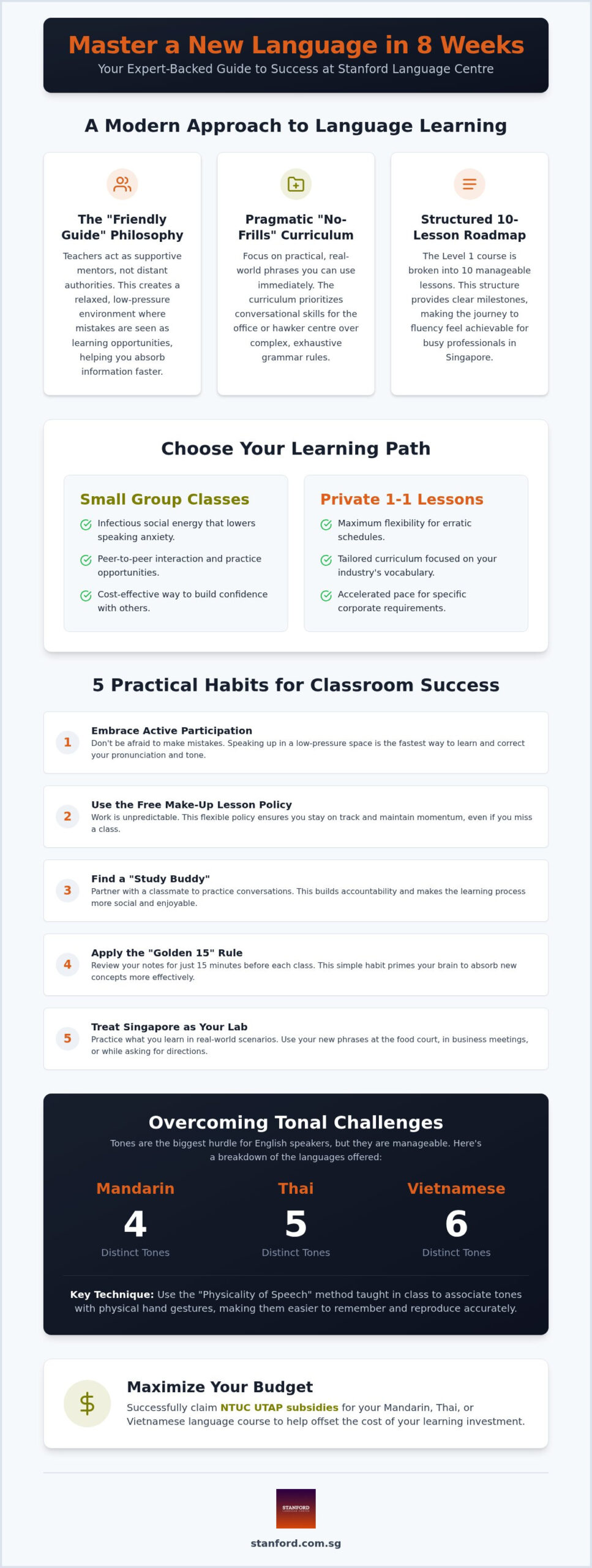
Learning a language shouldn’t feel like a trip to the principal’s office. At Stanford Language Centre, teachers act as supportive mentors rather than distant authorities. This “Friendly Guide” philosophy is one of the most important Tips for Stanford Language Centre success. It creates a relaxed, inclusive environment where you feel safe making mistakes. When the pressure to be perfect is removed, your brain actually absorbs information much faster.
The curriculum prioritizes pragmatism over complex theory. Traditional language education often gets bogged down in exhaustive grammar rules from day one. This “no-frills” approach is different. It focuses on useful phrases you can use at the office or the hawker centre immediately. By using the 10-lesson Level 1 structure, the school provides a manageable roadmap. It breaks down the daunting task of learning Mandarin, Thai, or Vietnamese into digestible milestones that fit into a busy Singaporean lifestyle.
The “Fluent in 2 Months” Promise
Can you really speak a new language in eight weeks? It depends on how you define “fluent.” For beginners, this promise focuses on conversational confidence. You won’t be debating philosophy, but you’ll handle basic daily interactions with ease. After 8 weeks, you’ll be able to introduce yourself, ask for directions, and manage simple transactions. Tracking your progress is straightforward because each lesson in the Level 1 curriculum targets a specific real-world scenario. It’s about being functional, not just academic.
Small Group vs. Private Lessons
Most students thrive in small group classes. The social energy is infectious and helps lower speaking anxiety. You’ll quickly realize that other professionals in Singapore share your same fears about mastering tones. This peer-to-peer interaction is vital for building confidence. However, if you have a highly erratic schedule or specific corporate requirements, private 1-1 lessons offer a tailored alternative. These sessions allow for an accelerated pace and focus specifically on your industry’s vocabulary. Whether you choose a group or private setting, the focus remains on practical, results-oriented communication.
5 Practical Habits for Classroom Success
Classroom time is a significant investment. To get the best results, you need a strategy. These Tips for Stanford Language Centre success focus on building habits that fit into your busy schedule. First, embrace active participation. Making mistakes in class is the fastest way to learn. Our teachers create a low-pressure space where a wrong tone is just a step toward a right one. Don’t be afraid to speak up and test your boundaries.
Singapore’s work culture is fast-paced. Meetings run late and business trips happen unexpectedly. Use the free make-up lesson policy to stay on track. This flexibility is key to maintaining your momentum throughout the Level 1 course. If you need specific words for your industry, engage with your teacher directly. They are partners in your journey and can provide tailored vocabulary for your professional needs. Finally, apply the “Golden 15” rule. Review your notes for 15 minutes before every session to prime your brain for new concepts.
Maximising Small Group Interactions
Small groups offer a social energy that apps simply can’t replicate. Find a “study buddy” within your cohort of expats or locals. Practicing together builds accountability and makes the process more enjoyable. Use your class breaks to test out conversational prompts with your peers. This group dynamic is particularly useful when navigating the L2 Acquisition and Processing of Mandarin Tone. Hearing different voices helps you master the nuances of Thai and Vietnamese tones more effectively than studying in isolation.
Leveraging Course Materials
Your Level 1 book is a practical roadmap for your first 10 lessons. Annotate your pages with personalized memory triggers that make sense to your daily life. Stanford’s structured handouts are perfect for quick reference at your desk or during a lunch break. To sharpen your ear, listen to the provided audio resources during your commute to internalize the natural rhythm of the language. Following these Tips for Stanford Language Centre success turns standard materials into powerful tools for fluency. If you’re ready to start, a small group Mandarin class is the perfect place to begin.
Overcoming Tonal Challenges in Mandarin, Thai, and Vietnamese
Tones are often the biggest hurdle for English speakers. It’s the primary reason many professionals in Singapore hesitate to start their language journey. However, tones aren’t as mysterious as they seem. Mandarin features 4 distinct tones, while Thai has 5 and Vietnamese has 6. One of the most effective Tips for Stanford Language Centre success is to stop viewing tones as musical notes. Instead, think of them as the “shape” of the word. A rising tone feels like asking a question; a falling tone feels like giving a firm command.
Our instructors advocate for the “Physicality of Speech” to build muscle memory. Don’t be shy about using hand gestures in class to mimic the movement of a tone. If the pitch goes up, move your hand up. This physical connection helps your brain categorize sounds faster. Before you try to speak perfectly, focus on ear training. Proficiency-oriented approaches, similar to those at the Stanford Language Centre, prioritize “doing” over just “knowing.” You must hear the nuance before you can reproduce it. English speakers often struggle because they try to apply sentence-level stress to individual words, but in tonal languages, the pitch is baked into the vocabulary itself.
Mandarin Tone Mastery for Professionals
Most beginners find the third tone the most challenging. It’s a dipping tone that requires a low, growly pitch. In fast-paced business conversations, the key is to keep it low rather than worrying about the “rise” at the end. Use pinyin as a temporary bridge to help you visualize the sounds, but don’t let it become a crutch. You want to connect the sound directly to the meaning. For a more comprehensive look at the local landscape, explore our 2026 Guide: Adult Chinese Learning in Singapore for deeper insights into mastering the language as an adult.
Thai and Vietnamese Pronunciation Hacks
Thai and Vietnamese require a slightly different mental toolkit. Try the “Anchor Word” technique by associating a specific tone with a familiar English sound or emotion. In Thai, vowel length is just as important as the tone. A short vowel versus a long one can change a word’s meaning entirely, so pay close attention to how long you hold a sound. For Vietnamese, focus on mastering the glottal stops. These sharp, clipped endings feel unusual at first, but practicing them in our small group classes makes them feel like second nature within weeks.
The Singapore Lab: Practicing in the Real World
Your classroom is just the beginning. One of the best Tips for Stanford Language Centre success is to treat the entire island of Singapore as your personal laboratory. Don’t wait for your final exam to start speaking. The “Food Court Challenge” is an excellent place to start. Try ordering your morning “Kopi” or your lunch “Cai Fan” entirely in Mandarin. Hawker stalls are fast-paced, which forces you to be clear and concise. It’s the perfect low-stakes environment to test your pronunciation in a real-world setting.
Another great way to practice is the “Taxi Test”. Singaporean drivers are often happy to chat. Engaging them in basic conversational practice helps you move beyond structured textbook dialogues. You’ll hear different accents and speeds, which is vital for real-world fluency. This multicultural environment offers a 24/7 language lab that few other cities can match. If you can handle a conversation during a 15-minute ride to Orchard Road, you’re well on your way to success. Every interaction is a chance to refine what you’ve learned in class.
Mandarin for the Singapore Workplace
Building rapport with Mandarin-speaking colleagues can transform your office dynamics. Simple phrases used during a coffee break can bridge cultural gaps and build trust. It’s important to understand the difference between “Singdarin” and the formal Mandarin taught at Stanford. While the classroom focuses on correct grammar and tones, your colleagues might use local slang or mixed-language sentences. Learning how to introduce yourself professionally in a small group setting gives you a solid foundation to handle these nuances with confidence.
Thai and Vietnamese for Regional Business
If your role involves regional travel, your Thai or Vietnamese skills are a major asset. Prepare for your next business trip to Bangkok or Ho Chi Minh City by focusing on practical phrases for meetings and networking. Transitioning from speaking to literacy is a big step, so start by reading basic signs and menus during your travels. Using Stanford’s corporate training modules allows you to tailor your learning to your specific industry. This ensures you aren’t just learning a language, but gaining a competitive edge in the regional market.
Ready to take your skills into the real world? Sign up for a small group Mandarin class today and start your journey toward fluency.
Financial Planning and Your Learning Roadmap
Investing in a new language is an investment in your career. However, smart professionals know that financial planning is just as important as study habits. One of the top Tips for Stanford Language Centre success is to map out your long-term roadmap early. Don’t just think about the first 10 lessons. Consider how you’ll maintain momentum as you move toward intermediate fluency. Whether you’re a business owner looking for corporate training solutions or an individual learner, understanding the available subsidies makes the journey much more sustainable.
For Singapore SMEs, the cost-benefit of corporate training is clear. Equipping your team with basic Mandarin, Thai, or Vietnamese skills opens doors to regional markets. It builds trust with partners and reduces the need for constant translation. Staying motivated after the initial excitement of Level 1 wears off requires a shift in mindset. Consistency always beats intensity. Five minutes of practice every day is more effective than a three-hour cram session once a month. By treating your education as a manageable habit, you ensure that your skills stick for the long term.
Navigating NTUC UTAP Claims
Maximizing your budget is easy when you use the available support. Many of our courses are NTUC UTAP claimable, which significantly lowers your out-of-pocket expenses. To ensure a smooth claim process, follow these steps:
- Verify that your specific Mandarin, Thai, or Vietnamese class is listed as a supported program before registering.
- Maintain a high attendance record, as most subsidies require you to hit a minimum 75% attendance threshold to qualify.
- Submit your claim through the NTUC portal within the stipulated window after your course ends.
NTUC members who are Singaporeans or Permanent Residents are eligible for UTAP funding to help offset their course fees. This financial cushion allows you to focus on your progress rather than the price tag.
Beyond Level 1: Building a Habit
Level 1 gives you the foundation, but Level 2 is where the real magic happens. This is the stage where you transition from memorized phrases to actual conversational flexibility. If your work schedule becomes too demanding for physical classes, explore our online language classes. They offer the same expert guidance with the added benefit of learning from your home or office. This flexibility is another one of the essential Tips for Stanford Language Centre success. It prevents life’s busy moments from derailing your growth. Ready to start your journey? Register for your Level 1 class today!
Your Path to Fluency in Singapore
Mastering Mandarin, Thai, or Vietnamese is a practical goal that fits your professional life. You’ve seen how a pragmatic methodology and consistent classroom habits lead to conversational confidence. By treating local food courts and taxi rides as your practice lab, you’ll turn lessons into real-world skills. These Tips for Stanford Language Centre success help you navigate tonal challenges while maximizing your budget through UTAP subsidies for eligible students.
We’ve been a part of the local community for over 20 years, focusing on a “no-frills” approach that prioritizes your growth. Our small group sizes ensure maximum interaction and support from our expert teachers. It’s time to move past the anxiety of learning a tonal language and start building new connections. Join our next intake and start speaking in 2 months! We can’t wait to see you in class.
Frequently Asked Questions
Is Stanford Language Centre suitable for absolute beginners?
Yes, absolute beginners are our specialty. Our Level 1 courses are built specifically for those with zero experience in Mandarin, Thai, or Vietnamese. We start with basic phonetics and essential survival phrases. You’ll find the environment very supportive. Teachers act as mentors to help you overcome initial hesitations. This approachable entry point is why many professionals choose us to start their language journey.
How do I claim NTUC UTAP for my Mandarin or Thai course?
You can claim your subsidy by submitting an application through the NTUC U Portal after completing your course. Ensure you’ve maintained at least 75% attendance and sat for all internal assessments. This financial support is one of the best Tips for Stanford Language Centre success for budget-conscious learners. Remember to apply within the stipulated period after your final lesson to receive your S$ reimbursement.
What happens if I miss a class at Stanford Language Centre?
Don’t worry if a last-minute meeting pops up. We offer a free make-up lesson policy to help you stay on track with your cohort. Just let our administrative team know as soon as possible. We’ll find an alternative session for you to attend during the same week. This flexibility ensures you never fall behind in the 10-lesson curriculum despite a busy Singaporean work schedule.
Can I learn Thai or Vietnamese if I only speak English?
Yes, you can definitely learn these languages even if you only speak English. Our instructors use English as the primary medium of instruction for all beginner levels. We use phonetic systems like pinyin for Mandarin and similar guides for Thai and Vietnamese. You don’t need to learn complex scripts immediately. We focus on helping you speak and understand sounds first to build your conversational confidence.
Are the Mandarin classes at Stanford suitable for Japanese or Korean speakers?
Absolutely, we offer specialized Mandarin classes tailored for Japanese and Korean speakers. These learners often have different strengths, such as a familiarity with Chinese characters or similar grammatical structures. By grouping students with similar linguistic backgrounds, we can move at a more efficient pace. This targeted approach helps you leverage your existing knowledge to achieve fluency much faster than in a general interest class.
How long does it take to become conversational in Mandarin?
You can reach basic conversational fluency in just 2 months. Our Level 1 course consists of 10 lessons held over eight weeks. By the end of this period, you’ll be able to introduce yourself, order food, and handle simple business introductions. While mastery takes longer, our pragmatic focus ensures you’re functional in real-world Singaporean settings very quickly. It’s about results over theoretical complexity.
Does Stanford Language Centre offer online classes for busy professionals?
Yes, we provide online Mandarin, Thai, and Vietnamese classes for those who can’t attend in person. These sessions offer the same interactive experience as our small group classes but with the convenience of learning from your home or office. It’s a perfect solution for busy professionals who travel frequently. Accessing these digital sessions is one of the top Tips for Stanford Language Centre success for those with erratic schedules.
Why doesn’t Stanford Language Centre accept SkillsFuture credits?
We focus on NTUC UTAP subsidies rather than SkillsFuture credits. This choice allows us to streamline our administrative processes and keep our course fees competitive for all students. While you can’t use SkillsFuture credits here, the UTAP claim provides significant savings for eligible NTUC members. We believe this focus offers the best value for professionals looking for high-quality, conversational language training in a supportive environment.